In this article, we will talk about the latest Preview Build for Windows 11 26H2 in the Dev Channel, which is the Build 26340.9354.
Windows 11, version 26H2 represents Microsoft’s yearly second half major update as part of their standard annual Windows 11 update cadence. As Windows 11, version 26H2 shares the same servicing branch as Windows 11, version 25H2, the update is implemented through an enablement package (eKB). This means your device will be updated to the next version through a single restart – providing a familiar, fast, and reliable update experience.
Devices already enrolled in the Experimental channel will begin seeing their versioning updated to version 26H2 under Settings > System > About (and winver). If you are in the Beta channel and would like to switch to the Experimental, you can easily do so under Settings > Windows Update > Windows Insider Program. Remember, you can easily switch back to Beta at any time, without having to do a full Windows reinstall.
Not currently enrolled in the Windows Insider Program and wanting to preview version 26H2? Register for WIP selecting the Dev channel, while it’s transitioning to Experimental. Once the transition is complete, the new channel name to preview version 26H2 will appear as Experimental.
New Cross-Device Resume
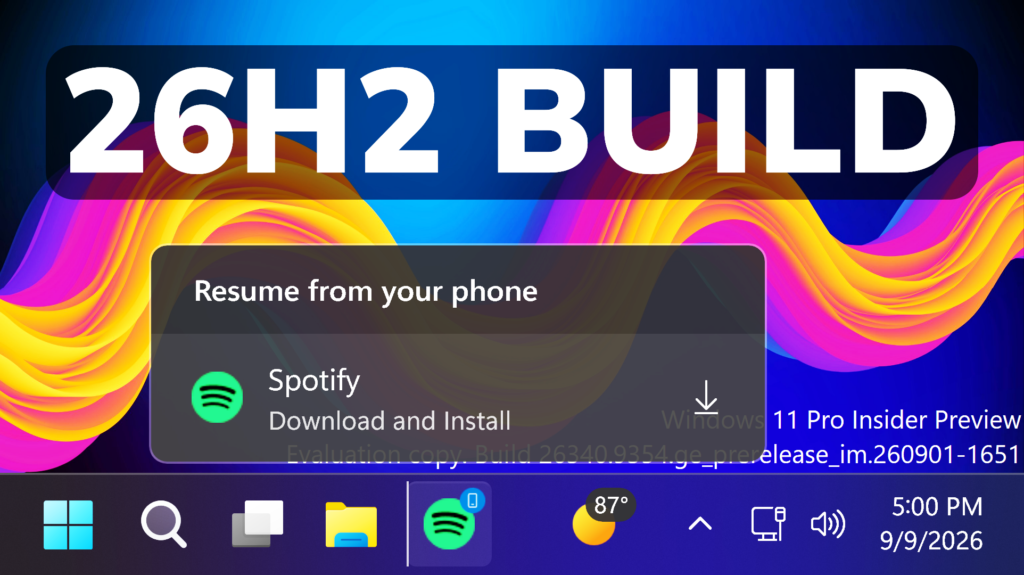
Microsoft is making it easier to continue where you left off on your PC. When you resume a webpage from your phone and the phone’s browser isn’t installed on your PC, the Resume hovercard now gives you two options: open the page directly in your PC’s default browser or install the phone’s browser for a native experience. This update helps you continue your work immediately without requiring an app installation first.

New Settings Home
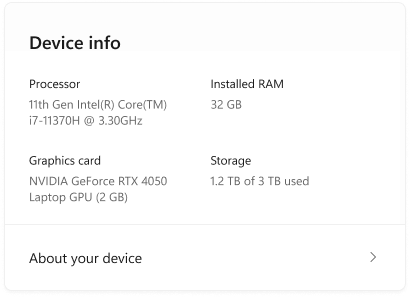
- Microsoft is beginning to expand the new Device Info Card experience for Settings Home to additional markets globally. Available for Windows Insiders signed in with their Microsoft account, the Device Info Card provides a quick snapshot of your PC’s key specifications and usage. From the card, you can go directly to Settings > System > About to see more detailed information about your PC.
- Note: We’ve been previewing the Device Info Card with Windows Insiders in the U.S. and on Settings Home for IT-managed PCs signed in with a Microsoft Entra ID.
New Auto Dark Mode Feature
New Privacy & Security Settings Page
The improved Privacy & security page in Windows Settings helps you find the Camera, Microphone, and Location privacy controls more easily. It groups similar controls across the page and brings usage information from deeper linked pages onto this page.
New Taskbar Animations
Microsoft is restarting the rollout of enhanced taskbar preview animations, providing smoother transitions between app groups.
New Assisted Setup in OOBE
Assisted Setup is a new, optional way to finish setting up a Windows PC. At the end of setup, you can choose to have Windows guide you through installing apps, personalizing your device, and getting up to date so that the PC is ready to use. The experience is entirely optional, and you can skip it to go directly to the desktop.
New File Explorer Search
Key file information, such as name, location, and date, now appears in a consistent layout on the File Explorer search results page, making search results easier to scan.
New Sound Settings
- We’ve updated the design of the volume sliders in Sound Settings so that they display audio activity on the side when audio is playing.

- If your audio device supports hardware acceleration, an option to allow hardware acceleration is now available in the Advanced section of the device’s properties.
- You can now configure exclusive mode for an audio device in the Advanced section of the device’s properties, so you don’t have to go to Control Panel.
- You can now configure adaptive communication sound levels, which reduce the volume of other sounds when communications activity is detected, directly in Settings.
- The option to set an audio device as the default sound device for communication now always appears in Properties. The option is unavailable if the device is already the default instead of being hidden.
- We’ve updated the text for allowing audio devices to make it clearer.
- We’ve added a new banner when mono audio is enabled to make it clear that some properties don’t take effect while mono audio is active.
- We’ve updated the All sound devices page:
- You can now change default devices from this page.
- We’ve adjusted the page design so that you can filter whether you’re viewing input or output devices.
- We’ve added toggles so that you can choose whether to hide or show disabled, disconnected, and unplugged devices.
- We’ve also updated the input and output audio properties pages in Settings to include jack information for devices that need it.
Improved Family Safety
Improved family safety messaging when applications are blocked because of age-restricted parental controls.
New Narrator Features
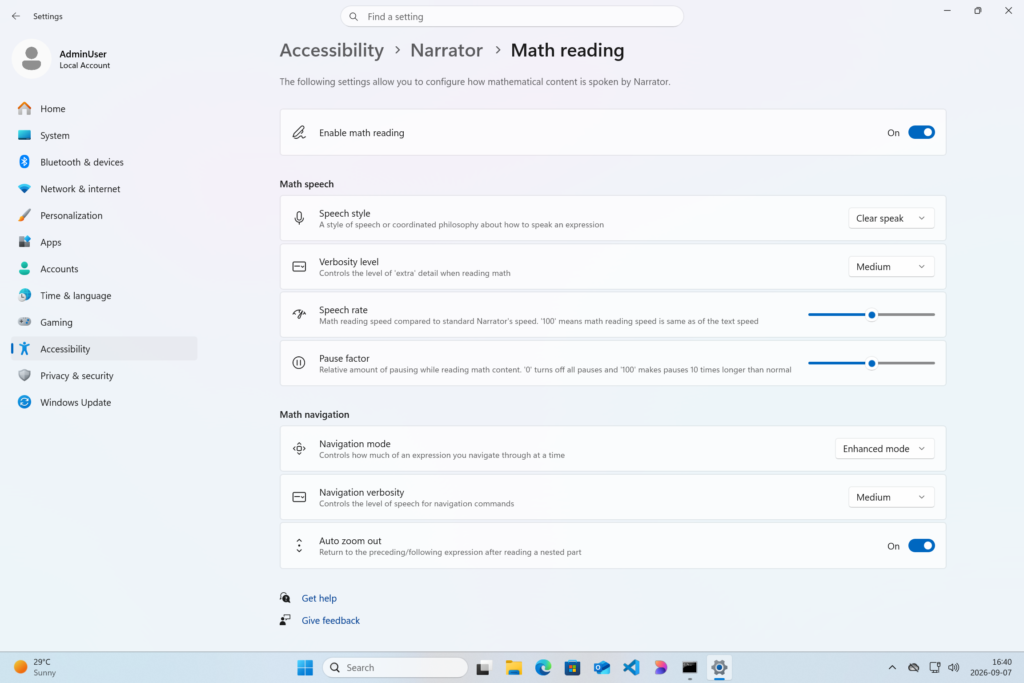
Microsoft is adding math reading and navigation support in Narrator, bringing clearer and more natural math experiences to users who are blind or have low vision. Math is at the heart of STEM education and learning, and this update helps students and professionals independently read, understand, and explore equations, formulas, and scientific notation with confidence.
New Magnifier Features
- More and more of the work people do happens across more than one screen. You draft on one display and keep source material open on another. You fill in a form while a reference document sits beside it. Those extra displays can be more helpful when each one can do its own job, and now Magnifier supports exactly that.
- To use this update, set your monitors to Extend in System > Display, not Duplicate, so Windows treats each screen as its own space.
- Every screen keeps its own view at its own zoom. In earlier versions of Magnifier, zooming in stretched a single magnified view across all of your displays, so one screen’s zoom followed you everywhere and screen edges blurred together. With this update, each monitor’s boundary is respected, and each monitor can have its own zoom percentage. Your writing screen can be at 300% while your reference screen stays at 150%, and the magnified view no longer spills from one display into the next. This behavior matters because different tasks and screen resolutions often require different levels of magnification to remain comfortable to read.
Setting the zoom on each screen is easy. Choose whichever method feels natural:
- Move your mouse pointer onto the screen you want to adjust, then press Windows key + Plus (+) or Windows key + Minus (-), or hold Ctrl + Alt and rotate your mouse wheel.
- Set the percentages directly in Accessibility > Magnifier.
- Drag the Magnifier toolbar onto a specific screen to adjust that screen from its on-screen controls.
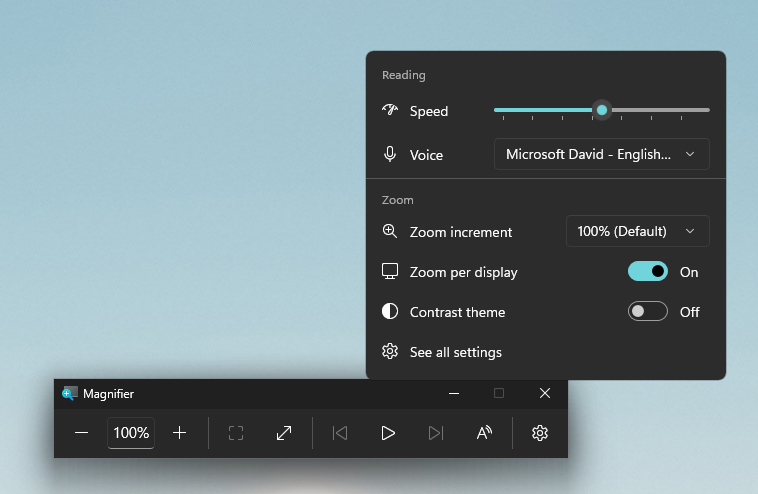
- Per-monitor zoom is turned on by default. If you prefer the classic behavior where a single zoom spans all of your displays, you can turn per-monitor zoom off at any time from either the Magnifier toolbar or Accessibility > Magnifier. You can turn it back on whenever you like.
Keep the view that matters, right where you need it
- As you move your mouse from screen to screen, the magnified view naturally follows your pointer. Sometimes this might cause you to lose sight of the content that you’re actively working on.
- Viewport locking keeps that view in place. For example, you might be drafting an email based on a section of a document open on another display. Position that display so the paragraph you need is in view, press Ctrl + Windows key + K, and the screen holds its view steady while you move your cursor over to write. The locked screen stays fully live and interactive, so you can glance back, click, or copy from it whenever you need to, and its view stays put until you release it.
- A message appears on the screen when it’s locked, so you always know what’s being held. To lock or unlock a screen, point your mouse at that screen and press Ctrl + Windows key + K again. To release everything at once, press Windows key + Esc to dismiss all locks. You can change the lock shortcut to Ctrl + Alt + P in Accessibility > Magnifier.

New Fonts Improvements
Unicode has announced the encoding of two African writing systems in recent Unicode releases:
- Garay was encoded in Unicode 16.0, released in September 2024.
- Beria Erfe was encoded in Unicode 17.0, released in September 2025.
New Modern Print Management
- Microsoft is temporarily removing the modernized Print Management experience from Windows Insider Preview builds while we continue refining the experience based on feedback. The existing Print Management tools remain available and are unaffected.
- They plan to bring the updated Print Management experience back to Windows Insiders in a future build after additional improvements are complete.
New Notification Center
Notification tips can now be saved to Notification Center after they’re dismissed or time out, making them easier to find again later.
Taskbar Fix
Fixed an issue where the taskbar app preview window might not respond correctly to dark and light mode changes.
Input Fix
Fixed an issue causing the mouse cursor to move in the wrong direction on portrait monitors for some Insiders after the latest flights.
Admin Protection Fix
Fixed an issue in the previous flight that caused the UAC dialog not to appear for some Insiders when Admin Protection was enabled.
BSOD Fix
Fixed an issue that caused some Insiders to see a SYSTEM SERVICE EXCEPTION bug check after the previous flight when launching or closing certain apps.
Known Issues
- They’re working on a fix for an issue causing mouse cursor customization not to work correctly.
- They’re working on a fix for an issue causing desktop background customization not to persist after a reboot.
For more information about this Build, you can check this article from the Microsoft Blog.
For a more in-depth presentation of the New Build, you can watch the video below from the youtube channel.
 11
11
 20
20