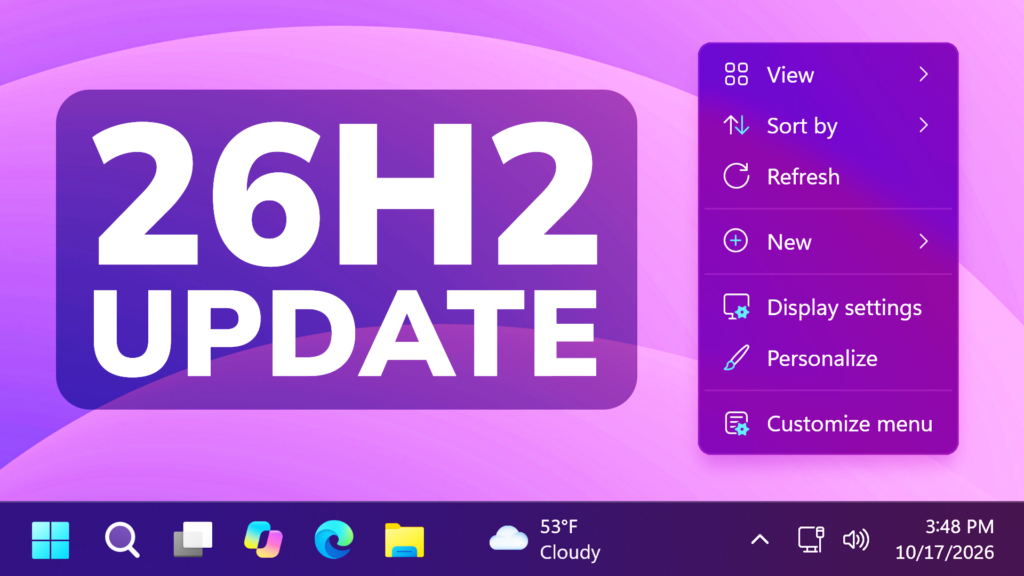
In this article, we will talk about the latest Windows 11 25H2 and 26H2 Insider Preview Build for the Release Preview Channel, which is the Build 26300.9807 or KB5127936.
New Features in this Update
[File Explorer]
- This update introduces an updated context menu that’s faster, simpler, and more customizable. The updated menu opens more quickly, reduces clutter, and gives you more control over the commands and app extensions that appear when you right-click.
- You can now customize the context menu to better fit how you use Windows. Select Customize menu at the bottom of the context menu to open its Settings page:
- Turn built-in Windows commands, such as Send to and Create shortcut, on or off.
- Add commands such as Print to the context menu.
- Choose which app extensions appear in the main menu or a submenu, or hide the app extensions submenu.
- Display Cut, Copy, Paste, Rename, Delete, and Share directly in the menu instead of as a row of icons.
- Move Properties to the bottom of the context menu.
- To personalize the context menu, right-click and select Customize menu, then choose the commands, app extensions, and layout you prefer. No action is required to use the default configuration. To see more options, hold down Shift and right-click your desktop.
- Key file information, such as name, location, and date, now appears in a consistent layout on the File Explorer search results page, making search results easier to scan.
- The address bar now supports
~, making it quicker to navigate directly to your user profile folder and subfolders, for example,~\AppData. - This update enables dark mode support in the Folder Options dialog in File Explorer.
[XBOX mode]
- This update introduces a refreshed Gaming Task View experience in XBOX mode, featuring a new navigation bar that provides quick access to Exit to Desktop and Power Options, making key system actions easier to access while gaming.1
[Settings]
- This update improves the Privacy & security page in Windows Settings by grouping related Camera, Microphone, and Location privacy controls and elevating usage information from linked pages onto the main page.
- The Device Info card on the Settings Home page, first introduced in the March 2026 preview update (KB5079391), is expanding to additional markets. Available to users signed in with a Microsoft account, the card provides a quick view of key PC specifications and usage, with more detailed device information available under Settings > System > About.1
- This update makes some small visual refinements to the design of the temporary files section under Settings > System > Storage.
[Phone Link]
- You can now hover over a recent message or notification in the Recent section to preview its content directly in Start without opening the item. You can manage this experience under Phone Link > Settings > Start menu personalization.
[Taskbar]
- This update improves animations of app window previews when you move the mouse across app icons in the taskbar.
- This update improves the underlying state persistence of taskbar settings related to multiple monitors across monitor connections and disconnections.
[Magnifier]
- Magnifier now includes a contrast theme toggle that can reduce screen glare while keeping the original colors in photos, videos, and charts. The toggle applies a dark contrast theme by default and is available from the Magnifier toolbar. To choose a different contrast theme, go to Settings > Accessibility > Magnifier. Color inversion remains available as a separate option.
- Magnifier now supports per-monitor zoom, allowing each display to use its own zoom level while keeping the magnified view within that display. To use per-monitor zoom, set your displays to Extend under Settings > System > Display.
- To adjust a display, move your pointer to it and press Windows key + Plus (+) or Windows key + Minus (-), use Ctrl + Alt with the mouse wheel, or move the Magnifier toolbar to that display and use its controls.
- Per-monitor zoom is on by default. You can turn it off or adjust individual zoom levels from the Magnifier toolbar or under Settings > Accessibility > Magnifier.
- Magnifier now supports viewport locking for multi-monitor setups with per-monitor zoom turned on. It keeps the magnified view on a display in place while you move the pointer to another display. The locked display remains interactive. Point to a display and press Ctrl + Windows key + K to lock or unlock its view.
- Press Windows key + Esc to release all locked displays.
- You can change the lock shortcut to Ctrl + Alt + P under Settings > Accessibility > Magnifier.
[Live Captions]
- This update improves Live Captions with a new Include screen reader audio setting, which is off by default. With the setting off, Live Captions won’t transcribe audio from screen readers such as Narrator, JAWS, and NVDA, keeping captions focused on microphone and system audio. To turn on this setting, go to Settings > Accessibility > Captions.
[Narrator]
- Narrator now supports reading and navigating math equations in supported Microsoft 365 apps, including Word and PowerPoint, and supported web content in Microsoft Edge (version 153.0.4234.32 and later) and Google Chrome (version 153.0.8010.18 and later). This makes it easier for users who are blind or have low vision to understand and explore equations, formulas, and scientific notation.
- Press Narrator key + Alt + N to turn on math navigation and use the arrow keys to explore parts of an equation. Press Esc to exit.
- Math reading supports English (United States), English (United Kingdom), Traditional Chinese, Finnish, German, and Spanish. You can change the language and other math reading preferences in Narrator settings under Accessibility > Narrator > Math reading.
[Family Safety]
- This update improves family safety messaging when applications are blocked because of age-restricted parental controls.
[Recovery]
- This update enables Windows Recovery Environment (WinRE) to automatically reuse eligible Wi-Fi profiles already saved in Windows, including supported certificate-based networks. Devices can now get online automatically during recovery scenarios such as quick machine recovery or cloud rebuild, without preconfiguring Wi-Fi credentials in WinRE. This capability is on by default, and IT admins can disable it. This feature was previously disclosed last month and is now beginning to roll out. For more information about networking in WinRE, see Windows Recovery Environment (Windows RE).
[Cloud rebuild]
- This update introduces Cloud rebuild, a new recovery option that reinstalls Windows 11 using a Windows image and device drivers downloaded from Windows Update, including when Windows is unable to start. No USB media or custom image is required. Cloud rebuild includes:
- Drive sanitization: Choose to remove your files or securely erase data using the storage hardware’s erase capability before Windows is reinstalled. Sanitization is irreversible.
- Remote management: IT administrators can configure and start a Cloud rebuild remotely through the Recovery CSP using either the currently installed build or a specified target build.
To start Cloud rebuild:
- In Windows, go to Settings > System > Recovery, and then select Rebuild PC. The device restarts into the Windows Recovery Environment and starts Cloud rebuild.Alternatively, if Windows can’t start, the device enters the Windows Recovery Environment automatically after repeated boot failures. From WinRE, select Troubleshoot > Recovery and uninstall > Cloud rebuild.
- Connect to a wired Ethernet or Wi-Fi network.
- Review the target Windows build, edition, and language, and then confirm the data loss warning before the rebuild begins. You can choose whether to remove files or remove and sanitize files before Windows reinstalls.
For more information, see Cloud rebuild.
[Microsoft Edge on Windows]
- This update introduces accelerated app launches that make opening Microsoft Edge feel faster and more consistent. When you select a link or open Edge from the taskbar or Start menu while Edge is already running in the background, Windows now routes your request directly to the running instance instead of first starting an extra, temporary process. Removing that step shortens the launch path, so Edge responds more quickly, most noticeably on busy devices when you’re multitasking. This is the first step in a broader Windows capability that any app can adopt to speed up its own launches.
[App management]
- Policy-based inbox app removal now supports multi-session environments. IT administrators can use the existing policy-based app removal capability to manage the removal of supported inbox apps on Windows 11 Enterprise and Education devices in multi-session environments.
[Adaptive hibernate policy]
- This update improves the adaptive hibernate policy to provide more instant-on resumes from Modern Standby while helping preserve battery life when the charge is low. Noticeable changes include less hibernation while the battery is above 80% and hibernating sooner when the battery is below 10%.
[Security]
- This update expands memory integrity protection across eligible devices. Supported PCs might now have memory integrity (HVCI) enabled during updates to help improve security and prepare devices for advanced Windows security features, while respecting existing user or IT administrator choices. For more information about memory integrity, see Enable memory integrity.
[Windows IPv6 networking support]
- Windows now supports IPv6 CLAT for Wi-Fi and Ethernet network interfaces, adding client-side 464XLAT translation so IPv4-only applications can continue reaching IPv4 services from IPv6-only networks. This helps organizations advance IPv6-only deployments while preserving compatibility for legacy IPv4 application scenarios.
- Prefix discovery: PREF64 is discovered through Router Advertisements (RA) by default, with DNS
ipv4only.arpaavailable as a fallback. - Requirements: CLAT requires SLAAC-based IPv6 addressing. DHCPv6 Prefix Delegation and Windows Subsystem for Linux (WSL) aren’t currently supported.
- Configuration: Enable CLAT by using the following command, or use Group Policy under Network > TCPIP Settings > IPv6 Transition Technologies:Console
netsh interface clat set global permit=enabled pref64fromdns=enabled pref64fromra=enabled
- Prefix discovery: PREF64 is discovered through Router Advertisements (RA) by default, with DNS
[Data Protection API (DPAPI)]
- This update adds a warning before prompt-based protect and unprotect operations. The warning explains that this prompt-based experience will be retired in April 2027. If you or an app use these prompts, stop creating new prompt-protected data, use a supported non-interactive protection flow, and decrypt or migrate existing prompt-protected data before retirement. DPAPI operations that don’t use the prompt-based flow aren’t affected. For more information, see CRYPTPROTECT_PROMPTSTRUCT structure (dpapi.h).
[Windows Spotlight]
- This update makes underlying platform changes to generally improve Windows Spotlight reliability on the lock screen.
[Unicode]
- This update provides Windows text shaping support for Unicode 17.0, helping Windows correctly display and shape newly encoded characters and scripts. Unicode 17.0 added 4,803 characters, including support for four newly encoded scripts: Beria Erfe, Sidetic, Tai Yo, and Tolong Siki. These updates help keep Windows text support current as the Unicode Standard evolves and improve support for languages and writing systems used by people around the world.
[Remote Desktop]
- This update addresses an issue that prevented non-admin users from establishing Remote Desktop connections to remote devices with Administrator protection enabled. Affected connections might have failed with error
0xC000000Dand displayed the message, “The token that was passed to the function is invalid.” - This update addresses an issue that prevents the Specify thumbprints of certificates representing trusted .rdp publishers policy from being configured through Microsoft Intune.
[BitLocker]
- This update improves BitLocker pre-boot PIN retry handling to prevent unintended repeated submissions from causing TPM dictionary-attack lockout and recovery.
[Smart App Control]
- This update fixes an issue where you might be unable to turn on Smart App Control in the Windows Security app after it has been turned off. On affected devices, the option to turn on Smart App Control might be grayed out.
How to Enable All New Features
Thanks to phantomofearth for discovering this, follow him for more hidden features!
You will need to download ViveTool, which is a small app that will help us enable hidden features from Windows.
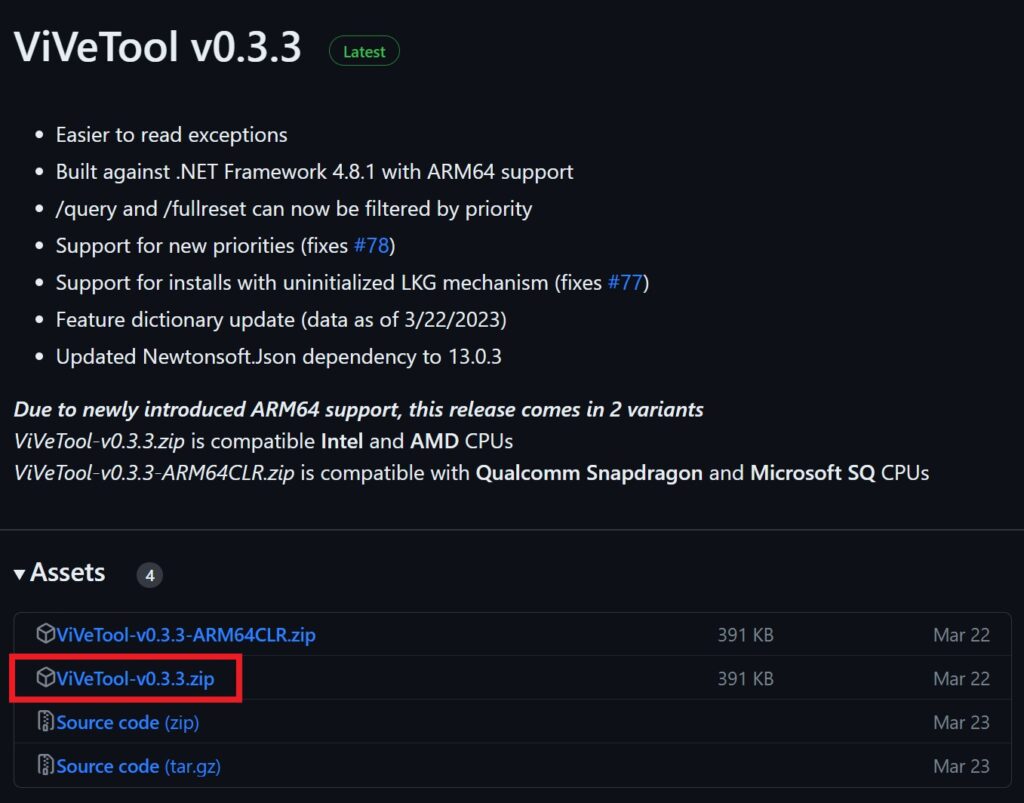
After you download ViveTool, you will need to extract the contents of the archive into a folder of your choice.
Right-click on the archive and then click on Extract all. Select Your Folder and then click on Extract. You will also need to provide some administrative privileges.
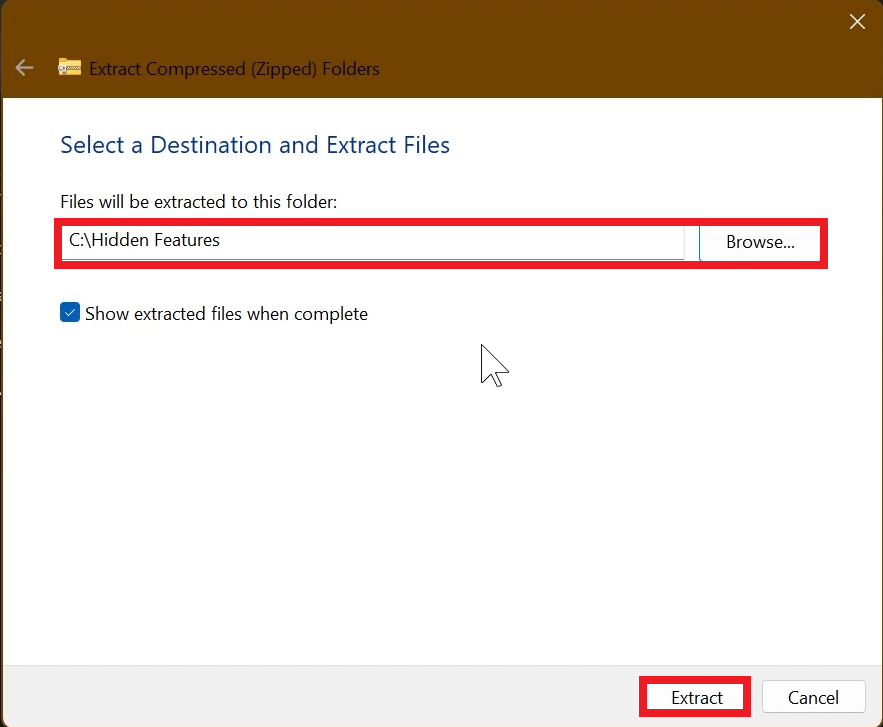
After you’ve done that, you will need to open CMD as administrator. Type the following command in CMD:
cd "your-location"Then copy and paste the following command:
Feature Bundle ID:
vivetool /enable /id:61161283New Context Menu:
vivetool /enable /id:60813048New AutoPlay Dialog:
vivetool /enable /id:62141177New Low Latency Profile for Files:
vivetool /enable /id:62816659New Folder Options with Dark Mode:
vivetool /enable /id:59203365New Temporary Files Settings Page:
vivetool /enable /id:61456288New Start Menu Phone Hover:
vivetool /enable /id:60682493New Tilde Support:
vivetool /enable /id:61815311New Task View in XBOX Mode:
Update All Apps in Microsoft StoreYou will now need to restart your computer, for the changes to take effect.
After the restart, you should be able to see the New Features on your Windows 11 PC.
For more information about this Update, you can check this article from the Microsoft Blog.
For a more in-depth presentation of the New Build, you can watch the video below from the YouTube channel.
 11
11
 20
20